

In marble, quality is not immediately visible.
Or rather: it isn’t for those who stop at the surface.
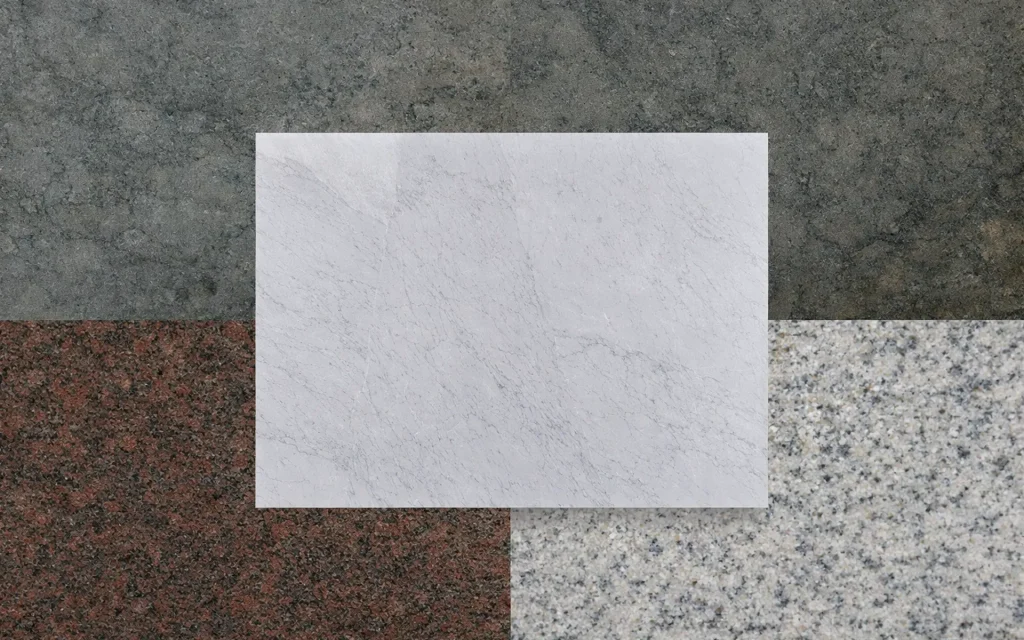
Two slabs may look similar at first glance, yet behave completely differently once integrated into a project. This is where the real difference emerges: between an aesthetic choice and a conscious one.
Material origin
Everything starts in the quarry.
That’s where the material’s potential is defined.
Not all quarries produce marble with the same characteristics: density, internal stability, and the presence of tensions or microfractures can vary. Quality marble comes from a sound, homogeneous, structurally reliable block.
This aspect is often underestimated because it is not immediately visible. Yet it determines durability, workability and final performance.
Slab selection
Once extracted, marble must be selected. This is where the level rises.
Quality does not depend only on the material itself, but on how it is chosen. Slab selection requires visual expertise and the ability to interpret the material.
It’s not simply about “choosing the most beautiful one.”
It means evaluating:
- pattern continuity
- balance between solid areas and veining
- consistency across multiple slabs, especially in large projects
A common mistake is evaluating a slab in isolation, without considering how it will interact with others. Marble, in most cases, never exists on its own.
Processing and finishing
Even the best marble can lose value if poorly processed.
Processing is what translates material potential into a concrete result. Cutting must be precise, the surface must be properly treated, and the finish must match its intended use.
Every finish is not just an aesthetic choice.
It affects:
- light perception
- wear resistance
- long-term maintenance
A polished finish enhances the pattern but can be more delicate. A honed or brushed finish completely changes the material’s character.
Intended use
Quality marble is not the most expensive.
It is the most suitable for the context.
The same slab may work perfectly for vertical cladding and be unsuitable for a kitchen countertop. Different stresses and technical requirements apply.
For this reason, selection must always start from the application:
- in bathrooms: moisture management
- in kitchens: resistance to stains and chemicals
- in cladding: visual continuity
Ignoring this step often leads to issues that appear only after installation.
Project consistency
The real leap in quality lies not in the single slab, but in the whole.
A marble project works when all its elements are coherent. Veining must follow a logic, slabs must interact, and the final result must feel intentional, not random.
This is where overall vision comes into play.
Choosing a good material is not enough — it must be orchestrated.
Conclusion
Recognizing quality marble means reading three levels simultaneously:
- material origin
- slab selection
- application within the project
When one of these elements is missing, the result loses strength.
When they work together, marble stops being a simple surface and becomes an integral part of the project.
Do you have a project and want to be sure you choose the right marble?
Contact us for a dedicated slab selection consultation.